
Part of the reason I've been writing about distribution and the importance of eventually betting on yourself was to gear myself up for Y Combinator Demo Day. For those unfamiliar, YC is the largest and arguably the best startup accelerator in the world. And it happens to be based in my backyard in San Francisco.
I've been a startup investor since 2002, a venture capital LP since 2006, and a private company operator since 2009 with Financial Tips. I've loved startups and the entrepreneurial life ever since spending my middle school years in Kuala Lumpur, Malaysia.
The families with large homes in the hills, the ones with the views and swimming pools, were all entrepreneurs. As an impressionable 12-to-14-year-old boy, I figured getting picked up in a black Mercedes 280 SEL with a chauffeur looked like a lot more fun than taking the bus. So it stuck with me early that entrepreneurship was the path to a potentially better life.
Unfortunately, I chickened out after college. In 1999, a family friend offered me a job in Shenzhen, China to run his eyeglass parts factory and potentially partner with him to build his business in a new country. I think he felt like I was the son he never had, as his daughter wasn't interested. Instead, I took the “safer” route and joined Goldman Sachs as a financial analyst in the international equities department. After 7 rounds and 55 interviews, it was too tough to turn down.
But ever since 1999, I've carried a lot of what-ifs about the adventure I didn't take. So when the world finally crashed in 2009, I figured it was now or never to start my own thing with the launch of Financial Tips. YC Demo Day was, in a way, reopening a door I closed 26 years ago.
Why Y Combinator Is Worth Showing Up For
Before I get into the day, let me explain why YC is a big deal.
YC is the most selective startup accelerator in the world. The acceptance rate is roughly 1%, which makes Harvard look easy to get into by comparison. Get in, and you receive $500,000 for about 7% of your company, three months of intense mentorship, and a network that opens doors most founders spend a decade trying to pry open.
Does the program actually work? The numbers say yes. About 4.5% of YC companies go on to become billion-dollar unicorns, versus 2.5% for other venture-backed seed-stage startups. Roughly 45% raise a Series A, compared to 33% for everyone else. To date, YC has funded more than 90 billion-dollar companies.
You also might have heard of a few of them. Airbnb. Coinbase. DoorDash. Instacart. Stripe. Reddit. Dropbox. YC is great at finding outliers early and pouring rocket fuel on them. It is also a fabulous business model.
So when better odds at a unicorn are on the table, you show up.
Y Combinator And Serendipity
I firmly believe most outsized success is due to luck. And my path to attending YC Demo Day is a great example.
Back in 2013, I played tennis with the co-founder of a roboadvisor called FutureAdvisor, a YC ‘10 company. His co-founder, Jon, happened to be a dad at my kids' school in the same grade. Jon went on to become a full partner at Y Combinator in 2023.
Here's Jon sharing advice on YC's Startup School.
Then it turned out one of the dads in my Pokemon Go group chat was a YC alum. For years we traded raid strategies and never once talked about work. Then his company, LanceDB, raised a Series A, and I thought to myself, why didn't I support and invest? It's simply because I had no idea what he did. Please ask people what they do, they might surprise you.
And then my softball buddy, who I also play poker with, mentioned his co-founder at AppThority was a dad at my school. That's how I got to know Domingo, whose kid is in the same grade as the son of Garry Tan, the President and CEO of Y Combinator. I first met Domingo at a first-grade dad event a couple of years ago, and he introduced me to the various types of tequila.
So with my love of entrepreneurship, my conviction that we're heading into an AI-driven future, and YC parents seemingly all around my school, I finally had to attend Demo Day. Thanks to Domingo, Garry, and the YC staff for having me.
Fantastic Energy And Creativity
The main takeaway is that YC Demo Day is a blast of adrenaline that makes you want to run through walls. You want to build products that solve hard problems. Then you start questioning whether your own work has enough purpose and meaning.
Over 1 billion people live with conditions like fibromyalgia, long COVID, POTS, ME/CFS, EDS, endometriosis, lupus, and MS. More than 15% of the world lives with some form of disability. And the hard truth is that as we age, most of us will face some illness that chips away at our quality of life. This is a market measured in human suffering, and almost nobody is building specifically for it.
Here's an interview I did with my friend Domingo Guerra, who founded a company and sold it to Symantec and is now a VC. Instead of staying at his cushy Broadcom job making lots of money, he decided to become a VC and do his own thing.
The Competition To Invest Is Tough
By the time Demo Day arrives, the companies with the most traction have already filled their funding rounds. So if you want a real shot at investing, you need to reach out to founders one to three weeks before. And if you aren't a recognizable angel or a VC from a known institution, getting in can be tough.
That said, there are still plenty of amazing companies open to new investors on Demo Day. And as every founder and investor knows, the first product is rarely the final product. Companies pivot and iterate constantly.
My favorite pivot is Slack. It started as an internal communication tool for a failed massively multiplayer online game called Glitch. The game shut down, the team rebranded the tool, and Slack launched in 2013. In 2021, it sold to Salesforce for $27.7 billion. Not bad for a side feature of a video game nobody played.
The biggest investment winners are almost always non-consensus. So just because you couldn't get into the YC company that grew to $1 million in annual recurring revenue within six months doesn't mean you've missed out. The next Airbnb rarely looks like the next Airbnb on day one.

What Angel Investors Should Bring To The Table
As an angel, if you aren't writing the biggest check, or aren't a celebrity, you'd better add the most value. The founders worth backing are the ones you can genuinely help. Here's what every angel should think hard about bringing to the table before showing up:
- Distribution. Access to a real audience of potential customers, the single hardest thing for an early-stage company to build from scratch.
- Introductions to customers who fit the founder's target profile.
- Help finding the right early employees to round out a team.
- Introductions to other investors for the next round.
- Operating expertise across product, marketing, and expansion, ideally earned the hard way by actually running a business.
My edge is distribution. Financial Tips reaches hundreds of thousands of financially sophisticated readers every month, exactly the audience many fintech and consumer founders want. Add 20 years of venture LP relationships and 17 years running a profitable business, and I can help with intros, the next round, and operating insights.
Be Proactive And Take Initiative
From an investor's standpoint, there are about 200 founders in each batch to track. So you have to do your homework beforehand and narrow the field to what's most relevant. Out of your shortlist, you might invest in just 10%, so you need to talk to as many founders as possible. Build your funnel.
I had five names on my list out of 196, focused on insurance, investing, real estate, and consumer where I knew I could add value. I had two great conversations and reached out to the other three online. They didn't respond, likely because their rounds were already full, which is the norm. No hard feelings. I believe in serendipity. If it's meant to be, it's meant to be.
A quick note on etiquette, because I've had differing opinions on how to approach founders. In the first meeting, I'm not a fan of interrogating a founder on their ARR, margins, cap structure, and burn rate. Instead, I want to build rapport first, listen to their story, and then follow up with the harder diligence questions afterward, when you have their attention and a real back-and-forth going. Relationships open doors that spreadsheets can't. But I understand the importance of getting to the point since there are so many decisions to be made.
Then there are the founders working the room for capital. Because I had a purple investor lanyard, founders knew to approach me and my companions during breaks, lunch, and happy hour if they were still closing their round.
I admired every one of the roughly 15 or so founders who came up to share their story. I made a point to listen, offer encouragement, and be helpful. It takes real courage to walk up to a stranger and ask for something. Because if you never ask, you never get. It reminded me of my dating years. If your success rate is only 5%, you'd better ask 20 times to get one yes.
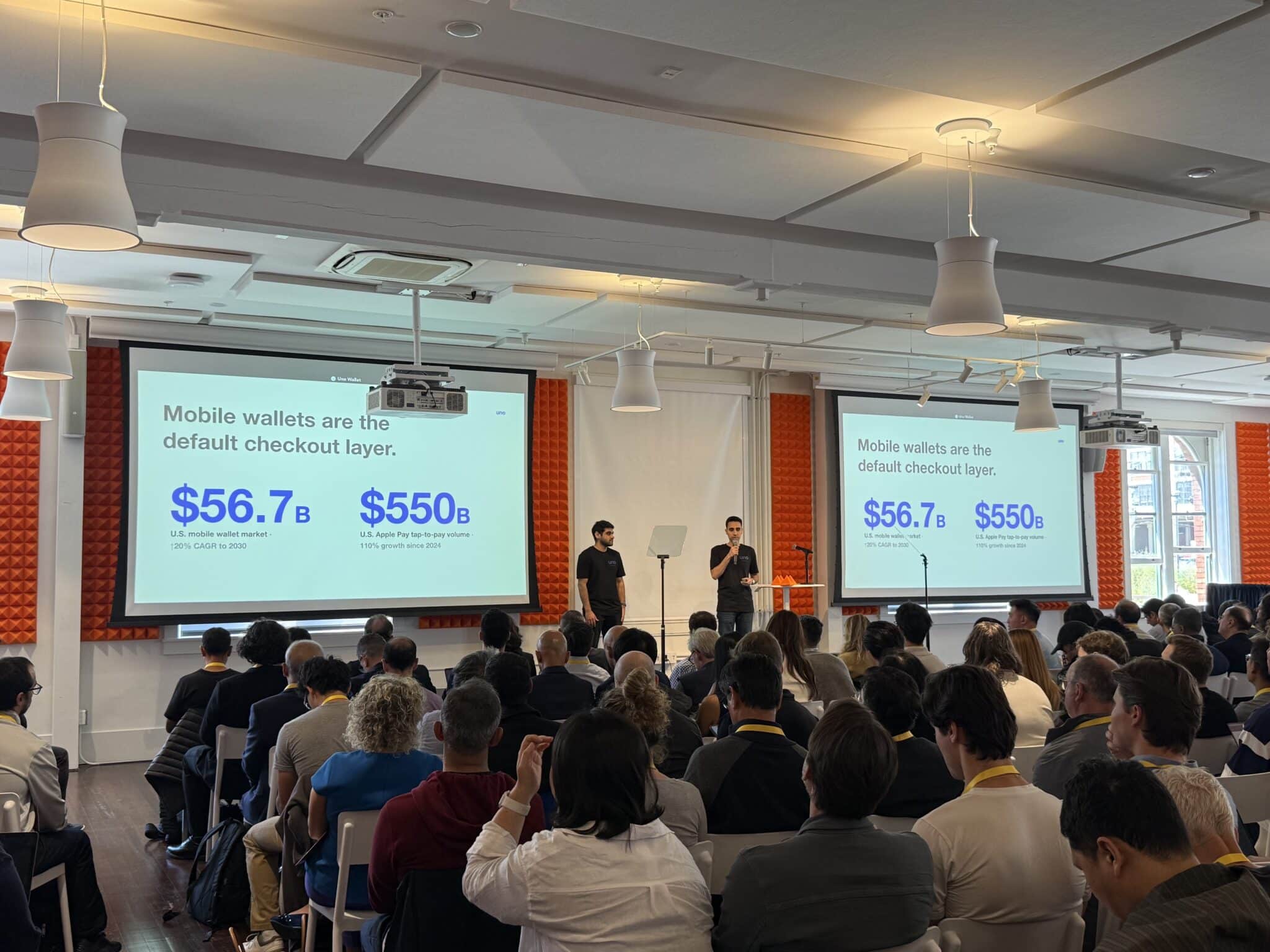
A Very Small World With Plenty To Eat And Drink
Demo Day also had endless free food and drinks, which most conferences do not. I appreciated the spread inside, plus all the food trucks and vendors outside. Hard to be in a bad mood with a taco and a beverage in hand.
Funny enough, I spotted the three GPs of another seed-stage fund I'm an LP in. They were doing their own diligence, trying to read the trends. Maybe they were even there to out-compete me on a deal. Who knows.
The key point is that the venture and startup world is small. If you want opportunities to invest, you have to be genuinely nice. Work on that emotional intelligence. The last thing you want is to get blackballed because you were rude to a founder, showed up 40 minutes late without an apology, or backed out of a handshake deal.
Be nice. Then be helpful. The more you help others, the more people want to help you.
Open To Invest
My final takeaway is that being an angel investor is hard. We already know how hard it is to be a founder who gets a company off the ground. A lot of folks like to poke fun at venture capitalists, thinking they have cushy lives and are all rich off their 2%+ management fees and 20% to 30% carry. But for most VCs not in the top tier, the job is an extensive grind.
The diligence required before you invest is a full-time job. For example, roughly 200 YC companies present per batch, and there are four batches a year. No single person can properly analyze all of them, so you have to niche down and accept that you'll miss plenty.
And even when you get the meeting and decide to invest, most startups won't return your capital, let alone generate life-changing wealth for you and your LPs. You build your portfolio deliberately, ideally 40 to 60 companies, help where you can, and wait 8 to 11 years to see results. And if not, you can always create a Summer YOLO Fund to live it up a little instead!
I hope to return to many more Demo Days and invest in more companies. I've set aside $150,000 a year for angel investing. Let’s see what happens as I share the journey.
And if you're a founder, YC or otherwise, raising capital and you think I can help, please reach out. My email is at the bottom of my About page, or you can leave a comment below.
Build on!
Are any readers investors in YC companies or YC founders? I'd love to hear about your experience. What percentage of your capital or how much are you allocating to investing in startups? Have you had any great successes?
Want to build financial freedom sooner, rather than later? Join 60,000+ readers and get my free weekly newsletter every Sunday morning. No fluff, no spam, just the same first-person insights on personal finance, real estate, startups, and financial independence I've been sharing since 2009. Everything I write comes from real experience, not theory.

Sam regarding your chronic back pain (or any back pain in the future you experience), and any other health issues, I recommend Dr Bradley Nelson’s book The Body Code. It is a phenomenal and incredibly simple healing modality that the reader can start using right away. The book teaches this system, and it works instantly.
I have been using it for a few years now on myself, my mother, my rescue animal companions and on many wild animals in need of help. (I am an animal communicator so this ties in perfectly with my work).
There are no words to express how it has given me complete peace of mind with my ageing mother, especially considering my mother is 82yo, and any niggles or more that she gets – I do a proxy session on her right away. It gives instant and lasting relief to her right away. Truly incredible and has to be used to really appreciate it! (It will blow your mind!)
It can be used remotely (using yourself as proxy) to help a living being on another continent or is can used by you, on yourself direct. You can also hire a practitioner to do a session for you, if you prefer. However, I prefer doing the sessions myself.
This is absolutely The way for future healing. Dr brad is a time served chiropractor who had his own practice and he healed many patients that doctors were unable to treat.
Thanks for the tip and glad it works! I will keep it in my for the future. I read Healing Pack Pain by Dr Sarno and my back pain went away after 3 months.
You are very welcome, and that’s great to hear that the book worked for you Sam. Well done on taking this holistic approach. Dr Sarno is right, it is trapped emotions that are the root cause of (any) pain. As Dr Bradly Nelson knew this too, he found a way to remove the pain immediately, by using muscle-testing to locate and then remove the trapped energy from the emotion with the use of a magnet over the governing meridian. Fascinating practical self help self-care.
So did you decide to invest in any companies?
I did! It’s in the post. Cheers
Sam,
I don’t typically reach out to writers whose work I follow online, but after reading your recent post on distribution as the last moat and seeing you at YC Demo Day, I wanted to send a brief note of appreciation.
I’ve followed Financial Tips for years, and while I may not fit the profile of your typical reader, much of what you write resonates with me. What I’ve always appreciated is that your work goes beyond personal finance and investing. You often explore the broader themes of entrepreneurship, risk-taking, reinvention, and the pursuit of meaningful work after achieving financial success.
Your recent observations on distribution particularly struck a chord. Having spent years building businesses and investing in startups, I’ve seen firsthand how the ability to reach customers, audiences, and communities often becomes a more durable advantage than technology alone. Great products matter, but great distribution frequently determines which startup ultimately wins. It’s a lesson that feels especially relevant today, when building products has become easier while capturing attention has become more difficult.
Another point that resonated was your emphasis on having the courage to pursue new opportunities despite uncertainty. Looking back, many of the most important inflection points in my own career came from decisions that were far from obvious at the time. I’ve moved across the country multiple times, changed industries, taken on increasingly ambitious leadership roles, founded and sold a business, and eventually transitioned into investing. None of those paths came with guarantees, but each opened doors that would have remained closed had I chosen the safer option.
As an investor attending YC Demo Day, I find that same willingness to embrace uncertainty is often one of the defining characteristics of exceptional founders. The most compelling startup founders are rarely the ones following a well-worn path. They are usually the people willing to leave comfort behind to pursue an idea that may not yet exist, with conviction that others initially struggle to see. Your writing captures that mindset in a way that is both practical and encouraging.
What continues to distinguish Financial Tips is the combination of firsthand experience, intellectual curiosity, and a willingness to share not only successes, but also the questions and tradeoffs that accompany building a career, a business, and a life. There is no shortage of tactical advice online. There are far fewer voices examining the longer-term challenges of entrepreneurship, startup investing, family, purpose, and what comes after financial independence.
In any case, I simply wanted to thank you for the consistency and effort you’ve put into Financial Tips over the years. Seventeen years of publishing thoughtful work, adapting alongside changing markets and technologies, and continuing to engage with readers is no small accomplishment.
While we’ve never met, your writing has provided perspective and encouragement at several points along my own journey. It was also a pleasure seeing you at YC Demo Day. I wish you continued success as you begin year eighteen and look forward to seeing what comes next.
Best regards,
Esteban
I imagine that entry to good deals is more competitive in SF than in smaller cities. I live in Northeast Florida, and there are angel networks here (e.g., Florida Founders). Last I checked (a few years ago) you could invest in a deal for as little as $5k. I attended some of the investment presentations, and teams were quite impressive, many with Mag 7 backgrounds. While my husband and I have done some private lending and some Family & Friends investments, we haven’t done any angel investing.
Nice to hear. There’s so much energy in the room, it’s infectious.
Yeah, I’m not sure $5K will fly as there is so much demand. The other “problem” is that even if you made a 20X, that’s still just $100K before dilution, and maybe only $80K or less after dilution. So you may need a 50X or a 100X to make it significant enough, but those, of course are so rare.
But it sure is exhilarating when it happens. And if you can help the startup scale, all the better.
This is great. Thanks for sharing. San Francisco is rocking and there seems to be so much opportunity to build, earn, and work.
This was an interesting read because I dabble in startups. But I have a question. You say you set aside $200,000 a year for angel investing. And you also said that one ideally would want to build up to 40-60 companies. How many companies does $200k get you? Aren’t there often fairly hefty minimums to angel invest?
You can invest between $10,000 the $25,000 has minimums. So over the course of three years, you can build a nice portfolio and diversified based on vintages.
What do you invest in and where do you get your deal flow?
A friend of a friend started his own VC firm. It initially was focused on healthy(ier) foods. These aren’t the kind of investments that will have huge multiples, but I am a customer (the ol’ Warren Buffet investing maxim). Then I started dabbling much smaller amounts in deals at Republic and Wefunder. I have about 13-15 investments so far, but while, for some, the valuations have gone up, none has yet cashed out. Covid didn’t help most of them. Apple’s tracking limitation has hurt others. Three have gone public recently, but the lockups are such that, while exciting at first, are getting brutalized since the IPO. I sometime get approached for other deals, but many of the minimums are $100k or $250k. Way more than I want to risk at the Angels, Series A stage.
Yeah, I can’t do $100K – $250K per private company investment, unless I allocate $10 million to private angel investing. But in order to be able to do that, I would need a $50 million overall portfolio, which I don’t have. Hence, $25K – $50K checks it is!
But I really enjoy being able to help, as well as meeting the founders and getting to know others. There’s a nice social element to venture investing, which is more valuable after you FIRE.
How fascinating. I don’t know much about YC except that it’s very hard to get into! Sounds like a very fun and insightful demo day experience. I’m always impressed by how many people have the guts, drive, and focus to take an idea and turn it into an actual working product or service. It’s much easier said than done and takes so much effort and sacrifice. Not everyone has what it takes to go the startup route and that’s why I always enjoy hearing about their stories and struggles on their journey to success. Thanks for sharing!
Thanks for sharing insights into YC. It sounds like a fantastic community and work. It’s also amazing is that there are also plenty of other startups that don’t do YC that do well as well.
But a key message I see is that being where all the action is certainly increases your luck surface area. Boom loop!
I love the message of betting on yourself and building great things the world needs. Juno sounds like a fantastic product to a growing problem.
Thanks for sharing insights into angel investing at demo day!