
When you were a kid, did you ever dream of growing up to be someone's exit liquidity? Probably not.
But every time you buy shares in a company IPO, that's exactly what you become. Whether being an early investor's exit liquidity is good or bad is hard to say in the short run. In the long run, you will certainly find out.
The main reason I've been investing a greater percentage of my capital in private companies over the past 20 years is because private companies are staying private for longer. More of the gains are accruing to private investors at the expense of future public investors.
SpaceX, for example, was founded on March 14, 2002. It's finally going to IPO 24 years later on June 12, 2026. Microsoft was private for 11 years, Google for 6 years, and Facebook for 8 years before they went public. Those who bought their IPOs and held on have done well. I'm not sure the same will happen for SpaceX.
So one of the most common questions I get from newsletter readers lately is: Will you be investing in the SpaceX IPO?
My answer is NO, for several reasons, despite the likelihood of its shares initially doing well post listing.
Don't Want To Be Exit Liquidity For Large IPOs
History is not kind to large IPOs ($1+ billion). Take a look at this chart highlighting the share price performance of select large IPOs by time period post-listing. Notice the final column, Year 1 Max Drawdown.
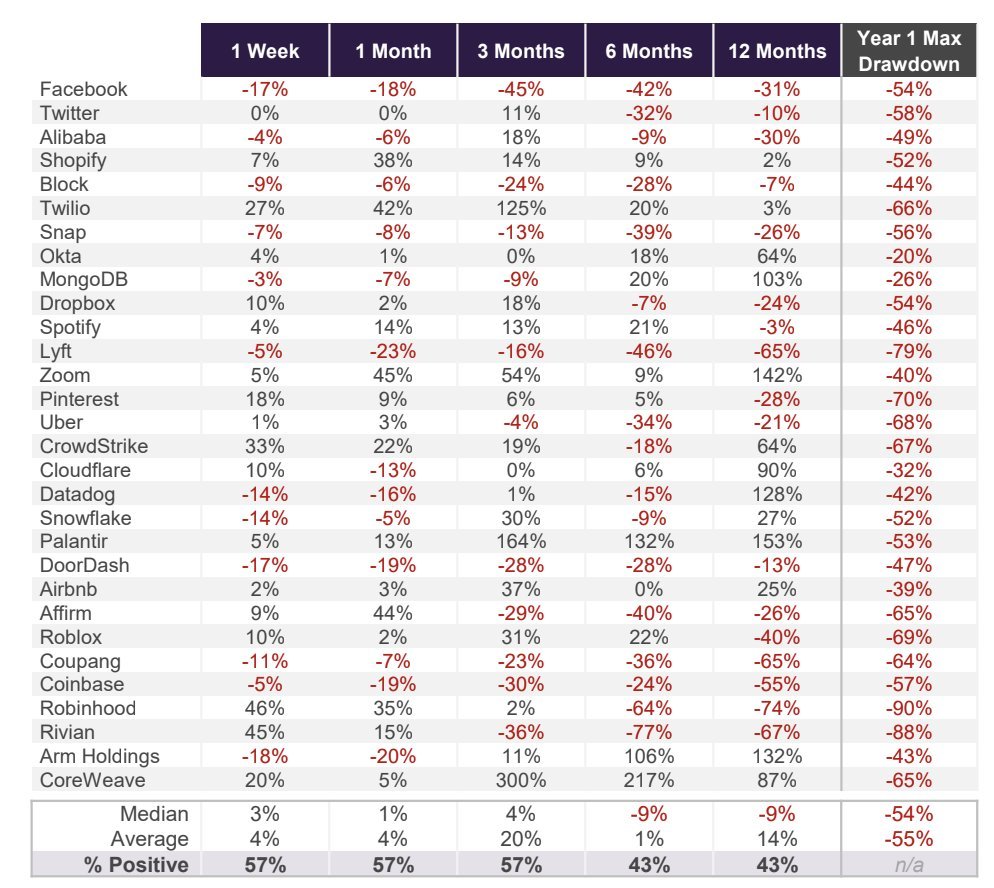
The downside gets worse if you buy a large IPO that gaps up and then you chase it. A more recent example is the Figma IPO (FIG) on July 31, 2025 at $33 a share. It gapped up and ran to a high of around $122. Today the share price is around $22. That is rough.
Don't Want To Be Part Of The Retail Frenzy
Ultimately, Morgan Stanley priced the Figma shares reasonably at the time. Retail frenzy was the main reason the share price spiked on day one.
I've been investing in public equities since 1996 and helped over 100 companies IPO during my days at Goldman Sachs and Credit Suisse. My experience is simple. More retail participation creates more volatility, because retail investors are classic paper hands and short-term holders.
So with SpaceX raising $75 billion, the largest IPO in history, and allocating 30% of the deal to retail, roughly $22.5 billion of shares, I see that as a net negative for share price performance, not a net positive.
The volatility is going to be wild. If you can get SpaceX at its IPO price, there is likely a greater than 70% chance the shares will trade up during the frenzy. However, if you're participating in the IPO, you'd better watch your position carefully the first several weeks if you can sell. Maybe even take the IPO day off to be a manic day trader, one of the worst things you can do for your returns.

Don't Want To Be Exit Liquidity At Outrageous Valuations
At the $135-per-share price SpaceX (SPCX) is targeting, valuing the company at roughly $1.77 trillion, its price-to-sales ratio will be more than 90-to-1. It’s the highest P/S ratio in IPO history. Even IPOs that came to market at half that multiple went on to underperform the market over the following three years.
Do you really want to be exit liquidity for a company trading at such an extreme valuation when the S&P 500 is also sitting at elevated levels with even more mega IPOs behind? I don't.
Here's a look back at all the companies that traded above 10x sales at the dot-com peak and what happened next.
- Yahoo: ~50x sales. Declined -97%. Didn't want to sell to Microsoft for $44 billion, and ultimately sold to Verizon for a tenth of that.
- JDSU: ~50x sales. Declined -99%. Stripped for parts.
- Qualcomm: ~30x sales. Declined -88%. Took roughly 20 years to break even.
- Amazon: ~30x sales at the peak. Declined -97%. Obviously a huge winner now, but not before a lot of pain.
- Microsoft: ~25x sales. Declined -65%. Took 16 years and 8 months to make a new high (October 2016).
- Cisco: ~25x sales, P/E above 200. Declined -90%. Finally broke its 2000 peak in December 2025, 25 years and 8 months later.
- Intel: ~13x sales. Declined -82%. Finally broke its 2000 peak in May 2026, almost exactly 26 years later.
- Sun Microsystems: ~10x sales. Declined -97%. Acquired by Oracle in 2009.
Investing at reasonable valuations matter. Buying at nosebleed levels at IPO is the greater fool theory in action, especially when the company isn't profitable. I had a front row seat to 1999 mania sitting on the GS sales / trading floor at 1 New York Plaza. You could have made a lot of money if you took profits at the right time. But plenty of investors lost their shirts within a year.
The better move is to wait for the hype to die down, then buy if you believe in the business and its growth trajectory. Don't let investing FOMO override your discipline. Retail has a fantastic way of bidding hot IPOs up to irresponsible levels, only for the price to course correct once management reports its first couple of quarters.

You'll Eventually Own SpaceX Anyway, So Why Chase It?
Here's the kicker. At a $1.77 trillion valuation, SpaceX debuts as a top-10 US company. Index funds will eventually be forced to buy it, which means you'll be forced to buy it too, automatically, through your S&P 500, NASDAQ, and total market funds.
You don't need to chase the IPO to own SpaceX. Wait a few quarters and the market hands you a position at whatever the real clearing price turns out to be. Let the index do the work.
And remember, most retail investors won't get significant IPO shares at $135 anyway. You'll get a small allocation based off your requested demand.
For almost everyone, “buying the SpaceX IPO” really means buying SPCX on the open the first morning, after it's already gapped up (or down). That's not buying the IPO. That's volunteering to be the exit liquidity.
Already Own Shares In SpaceX Through Venture Capital
Finally, I don't want to be exit liquidity for SpaceX because I already own funds that will likely sell part or all of their SpaceX holdings at IPO or after the lockup expires.
A traditional venture capital growth fund I invested in back in 2022 had about 10% of its fund in SpaceX as of 1Q2026. I expect them to eventually sell the entire holding, because they're required to return capital to LPs.
I also own a significant amount of the Fundrise Innovation Fund, VCX, which had about a 5% SpaceX position as of 1Q2026. VCX is not required to sell anything that goes public, since it's a permanent capital fund.
All told, I have a large enough position in SpaceX (~$300,000) that buying more would not be prudent from a risk/reward and asset allocation perspective. And even if I owned none of it through venture funds, I still wouldn't be buying the IPO for the above reasons.
I'd rather be using my finite capital to invest in other private growth company opportunities before they go public. Remember, every investment you make is an opportunity cost of not investing in another investment.
What I'd Actually Do Instead
To be fair, here's the case for buying and making millionaires rich instead of poor. Starlink is a real cash flow machine now, Starship could open up an entirely new market, and there's no comparable competitor. If you believe SpaceX becomes the AWS of space, $135 might look cheap in ten years. The growth upside is clearly there.
I'm not saying SpaceX is a bad company. I'm saying I don't want to pay any price for a great company. Price is what protects you when the story stumbles.
So what would I do? I'd wait. Let the lockup expire, let the first earnings reports land, let the frenzy burn off. If the business is as good as the bulls say, it'll be just as great at $110 as at $135. And if it isn't, I'll be glad I let someone else find out first.
If you just have to own shares, then buy with throwaway money you can 100% afford to lose. It is likely the frenzy will push the share price higher and you will have a window to profit from the IPO price.
But as a long-time Tesla shareholder, I sure hope SpaceX buys Tesla at a 50% premium.
Reader Questions And Suggestions
Readers, are you OK with being exit liquidity for a hot and expensive IPO? What's your strategy for buying IPOs? Are you buying the SpaceX IPO, and why? What price do you think it trades at after day one? And do you think these mega IPOs will suck liquidity out of the public markets and trigger a correction?
If you want to build more wealth than 94% of the American population, pick up a copy of my USA Today national bestseller, Millionaire Milestones: Simple Steps To Seven Figures. Life is much easier when you have more money.
If you want to achieve financial freedom sooner, subscribe to my free weekly newsletter and join 60,000+ readers. I launched Financial Tips in 2009 and helped kickstart the modern-day FIRE movement. Everything is written based on firsthand experience, because money is too important to be left to pontification.

Allocated 300 shares through Fidelity. Flipped@170, $10,500 profit for 5 mins work(Roth account).
Congrats. Were there any flipping restrictions on holding from your brokerage? Fidelity has a ban for 6 months if shares are sold within 15 days.
I did this in my Vanguard brokerage ROTH (bought and sold VCX over about a 2 week period in early May- maybe I was just outside of the window where restrictions apply) – no restrictions came up.
Cool. For those of us who bought before listing and were able to get at $18.97 a share or below there is a six month lockup period Post listing.
There’s often a big difference between the IPO list price and the first price at Trade for listings in Strong demand.
I’m in the same boat, though still waiting to hear the lock up time line as it’s staggered.
I took the profit and will gladly take the timeout. I utilize several brokerages.
I thought there were flipping restrictions?
I’m curious if you’re selling VCX? In other words did you buy that mostly for SPCX? Same question if you hold SATS.
Regarding lock-ups, the expiration is phased in, not a pure 6-month lockup.
The $135 price is something like 90x revenue and 40x forward revenue. Anyone buying at $135+ is pricing in that success a few years early and depending on enthusiasm and a low float to hold up that share price until we see promised revenue come in. It’s not impossible and still could achieve that in few years, or maybe the next few earnings will look incredible. It’s just the price I dislike, not the company.
It all depends on where VCX will be at lockup in mid-September, and the valuations of its underlying assets. If it’s at NAV or close, such as $40-$50, I’m holding. At higher levels, I will diversify by level as it is a large holding.
How about you?
I don’t have a VCX position. I asked out of curiosity about what investors are thinking about funds like VCX holding SPCX or have it through SATS as a proxy. For example, I notice SATS sold off presumably due to rotation into SPCX. However it now seems significantly discounted given the value of the shares they own and the spectrum that SPCX will still want. I wondered if I’m just missing something or if investors don’t appreciate this.
Cool. What’s the pitch on STATS?
SATS owns a 2 percent stake in SpaceX which they’ll receive in 2027, worth $40 – 46B at today’s price, has $20 – 22B debt, and still has assets spcx might want. Based on the assets alone the market seems to undervalue it a lot. It’s like a cheaper way to buy spcx shares than owning it directly. The downside is that debt risk. Barrons has also written about this.
Got it. Unfortunately, I don’t think 2% moves the needle much. It’s also a one off gain, so not ongoing operational.
Thanks for the feedback. I think you’re right. However I should have said I wasn’t making a “pitch” so much as looking at an idea. If I simply calculate ($46B – $22B) /158m shares = $151 value based on the SPCX shares alone, nevermind other assets or liabilities. Yet it closed at $114. Maybe that’s the cost of the risk here but it’s an interesting value.
SpaceX is issuing new shares and insiders are locked up for a while, so buying in the IPO is not really providing exit liquidity to anyone (in the short term) in this case. I am indirectly invested via Pengana Private Equity, which is listed on the Australian Stock Exchange. SpaceX is the their biggest holding. I was offered to participate in the IPO via Commonwealth Securities where I have an account who are the Australian manager for the IPO. Like you, at near 100 times sales and such a large amount of IPO shares, I was not enthusiastic.
Fascinating to see retail investors pile into SpaceX while the S&P 500 and the NASDAQ tanks. But the good thing is that people have their money to afford to gamble.
Sam, I did buy pre IPO, so you can imagine, I’ll be biting my fake nails on Friday morning. I’d be nice if people who are in the same boat as me, let us know how they are doing. With a 6 month lock up, I do realize that I’ll miss the huge initial surge.
What platform are you using that locks you up for 6 months after the IPO?
It was thru a private equity firm, the 6 month lock up is mandated by space x. This investment was done 1-2 years ago.
Ah, sounds good. Then you should be well in the money. Congrats!
I hope so, with the 6 month lock up, I’m nervous.
Thanks for this post, Sam. I’ve been following you since 2017 and own both of your books.
I’ve been explaining to friends and family that buying an IPO and actually making money is for Wall St. insiders, not regular folks.
Sharing your insights is valuable for those who don’t know better:
I laughed out loud with some of your comments.
I’ll also pass for now. I’d rather stock up more capital in my specially-designed whole life policy that I use as my safe liquidity warehouse to then invest in real estate.
There’s a reason even family offices and HNW folks keep their public equities exposure to roughly 25% -30% while diversifying into alternative assets up to 50-60% of their net worth.
The retail guy can make money on IPOs pretty easily, you just need to trade it early, and not invest. VCX, which Sam gave to all of us, you could have bought at 40ish at the market open and sold for $400 within a week or two. Could have been (and maybe was) a life changing windfall for some. Now whether in a year it is still above 40 is a different story. I buy IPOs all the time, just only for the trade, not the investment. I do this because, during bull markets, on average (more than 50% of the time), IPOs close up the first day and week of trading.I read recently that between 2022 and 2025 the average IPO gain the first day of trading was 13%. I will watch SPCX closely when it starts and go from there. I do think this one will close down within a day or two of trading. There is just too much hair on this one and too much publicity and seems to be marking an overall market blowoff top.
Great piece, as always Sam. Did you just talk me into shorting SpaceX? The problem is that the downside of shorting could be endless. Good advice for those bullish on it to only buy with throwaway money you can 100% afford to lose.
I wouldn’t short as I don’t see the price performance driven by fundamentals after listing for the first several weeks before public results.
The difference between $135/share and $200/share cannot be based on fundamentals at these valuations. So you’d have to be a seasoned day trader to try and get in and out, which I do not recommend.
Better to go for a walk in the park and smell the roses.
If you must short – look at SMH.
Thanks for the article and a fresh perspective given all the hype currently. I put in some IPO interest via Etrade and Fidelity, but aside from that, I am not going to chase immediate post IPO pricing. I don’t expect a lot of allocation given the current hype. Does anyone know what is the typical % of receiving shares? Does requesting more / less shares alter that number or is it totally random?
Let us know what percentage of your allocation you get. I’m not seeing those numbers yet.
Currently it is just letting me define what I would like (number of shares requested) I guess we will know when it is released.
I enjoyed this read, thanks for being so timely. Very true on getting exposure through the index and letting it do the work. And so true on needing to watch the market like a hawk and take off of work for those who are trying to get in on IPO. I will watch the pricing here and there out of curiosity for the first few days, but I will be staying out of that mess. I don’t need any extra unnecessary stress!
Hi Sam, can you help me understand how NASDAQ and FTSE Russell changed their rules to allow Space X to be admitted in as little as 5-15 days? For passive investors in funds such as QQQ this does not seem like good news as these funds will be forced to purchase Space X at elevated prices. I was pleased to see that the S&P kept their rules so Space X would have to wait and get profitable before being admitted.
I don’t know. I guess they are free to do whatever they want based on their bylaws.
I’d say that money talks and Musk gets what Musk wants
Morningstar describes the Space X IPO as “significantly overvalued.” Help me understand why Nasdaq and FTSE Russell changed their rules to allow Space X to be included into their funds after just 5- 15 days. This will force index funds such as QQQ to shell out billions for Space X at inflated prices. I was happy to see the s&p 500 refused to change, preferring to wait for Space X (just like all companies before them) to be invited in once they have proved themselves to be profitable.
So how does this benefit the passive investor in funds like QQQ?
I got pre-ipo pricing for airbnb at $65/share and was allowed to buy up to $10k for being a host. I sold at opening for $138. Easiest $10k I ever made
Congrats. How have your other IPO investments done overall?
That is the only one I participated in as I was guaranteed the $10k at the starting price point and JP Morgan didn’t have any flipping rules. I put in a pre-IPO interest for SpaceX through Fidelity for 100 shares. They have a 15 day holding period or face a 6 month flipping ban, but if it goes up I will sell same day again as I don’t care about being banned for 6 months as I’m not a very active trader.
Just updating. I got 100 shares.
Cool. Seems like it may open at $170 – $180 / share. Back of the envelop, I have about 1,500 – 2,000 total shares through two funds. Fingers crossed!
I 100% agree with you. Through Robinhood, I invested in a bunch of IPOs (I wanted and only got like 1 or 2 shares each) for fun. Every single one is down. The average is at least 50% down from the IPO price. There was a day when one could buy shares at the IPO and sell a week later for a profit. Now they run up so fast, that it makes little sense to invest in them because you can’t hope to buy at close to the IPO price anymore. Save the money and go play blackjack where the odds are better for you. I have “some” SpaceX through one of the side-funds that cropped up in earnest when the rumors of it going public got going through a seemingly reputable firm. I have no idea whether I’ll see my money again, but that’s less risky in my mind than the IPO. Also, I have some VCX too. Anyways, this will all be interesting, but I even expect VCX to take a hit eventually when the valuation drops to reasonably levels.
I recommend playing Texas no limit hold on Poker instead if you have the experience. So much more fun and a better age than 49% odds of winning.
Thanks for this article, Sam. I GovFIREd last year at age 53 thanks to Papa Musk and my taxable portfolio (it’s so true what you say about that being key to FIRE – I’m most grateful for my pension but because I retired early it doesn’t cover all of my expenses), and I am very conservative with my investments, but earmark a small amount to scratch the gambling itch :-P
I’m sitting on a nice long-term realized gain from META earlier this year, and expressed interest in the SpaceX IPO with Fidelity, into which I’d place these gains. But I’ve been on the fence so your article is helping me with my thinking.
Now I’m leaning to pass on SpaceX and get that 911 I’ve been drooling over!
Congrats! I would get that 911 before it’s too difficult to bend your knees.
Counter argument: SpaceX is the first company that could actually go to the moon.
Definitely possible. How much is that worth? And how much are you buying as a result?
The consensus is that the Space X $135 price tag overvalues the company by at least 50%. Every swingin’ dik is getting into this IPO and just about everyone has ACCESS to the 555 million shares. When does that ever happen? I’ll wait.